Buying guide
Lingerie sizing explained: fit, stretch and garment shape

Forget the number on your jeans for a moment. The best lingerie size is the one that works with the garment's least flexible point—its underband, cup, waist, hip, torso or leg opening—not necessarily the label you buy most often.
A stretchy bodystocking, underwired chemise, mesh teddy and jockstrap can share familiar labels while fitting very differently. Measure first, then look at the garment's construction and size chart. You can also visit Alexandria or Rydalmere to compare labels, cuts and packaging in person.
Take the measurements the garment actually uses
Use a flexible tape over underwear or light clothing. Keep it level and comfortably close without pulling it inward:
- Bust: around the fullest part, with the tape level across the back.
- Underbust: around the ribcage beneath the bust, for bras, wired cups and fitted bands.
- Waist: around the natural waist while breathing normally.
- Hips and seat: around the fullest point, with feet comfortably together.
- Torso: from the shoulder, through the crotch and back to the starting point. This is especially useful for teddies and bodysuits.
- Waistband: where you intend briefs, boxers or a jockstrap to sit—not automatically where your trousers sit.
Write the numbers down, then open the size chart for the garment or brand. If it is unclear whether the figures describe the body or the unstretched garment, ask us before guessing.
One size is a label, not a promise.
Let the garment type set the priorities
| Garment | Fit first | Useful adjustment | Check before choosing |
|---|---|---|---|
| Bra, bustier or underwired chemise | Underbust, bust and cup construction | Shoulder straps and hook-and-eye positions | Cup shape, band stretch, boning and non-stretch panels |
| Teddy or bodysuit | Torso, bust, waist and hips | Straps, halter ties and some back closures | Crotch position, leg opening, cup structure and body length |
| Babydoll or soft chemise | Bust or underbust, then the least-stretch seam | Straps, ties and back closure | Whether cups are wired, soft or open; what the set includes |
| Bodystocking or hosiery | Height, torso or leg length, hips and thigh | Usually very little | The brand's size range, knit density and band width |
| Brief, boxer or jockstrap | Waistband, pouch and leg opening | Drawcords on some styles | Brand chart, fabric stretch and where the waistband sits |
If your measurements fall across two sizes, give priority to the most structured area. Stretch lace may move with the hips while an underwire, fixed underband or boned panel does not.
Structure changes what a size label means
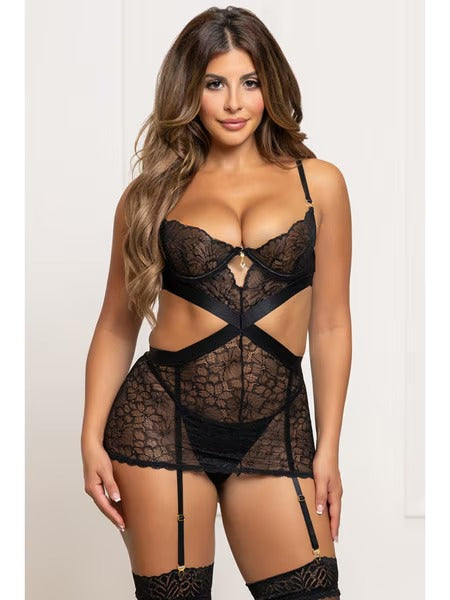
Two styles can share an O/S label and fit very differently. The Two Piece Lace and Satin Chemise Set pairs stretch lace with underwire cups, adjustable shoulder straps and a hook-and-eye back. The Two Piece Lace and Mesh Chemise Set has soft wireless cups, adjustable straps and side lacing.
The satin set depends more on the relationship between cup, underbust and closure. The mesh set loses the underwire, but its bust coverage and body length still need to suit you. Adjustable straps are helpful; they are not magic.


Stretch and adjustability are not the same thing
Stretch changes how fabric moves. Adjustability changes a particular point. One does not guarantee the other.
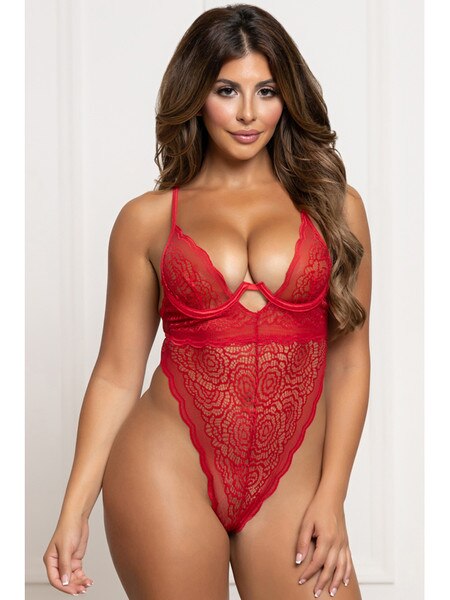
The Floral Lace Teddy combines soft stretch fabric, underwire support and adjustable shoulder straps. The straps change where it sits on the shoulder; they cannot change the underwire width or length through the torso.
The Fence Mesh and Lace Teddy uses a halter tie and back hook closure, giving you more control around the neckline and back. The plunge, thong back and one-piece body remain part of its fixed shape. Choose the silhouette you want, then see whether its adjustments sit where you need them.


What one size, O/S and Queen really tell you
They point to a range within that brand. They are not a universal sizing system.
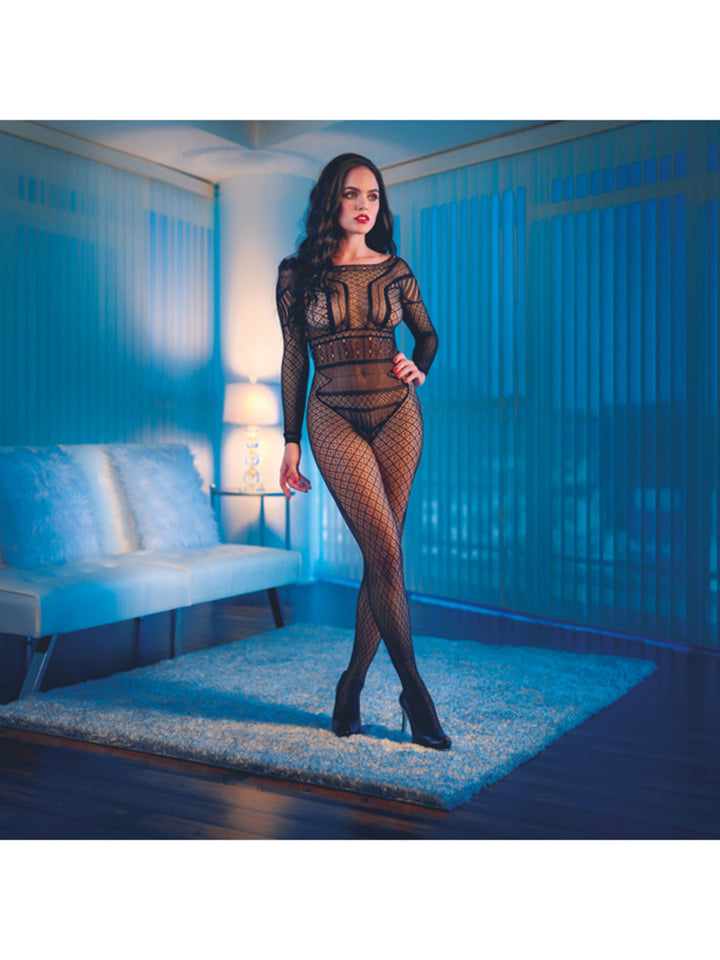
The Corset Front Suspender Bodystocking comes in separate One Size and Queen variants. The Scandal Full Length Lace Body Suit has its own named sizes and nylon-mesh construction. Match either label to the chart for the variant you are buying.
When a style offers only “one size fits most” without measurements, do not reverse-engineer fit from the model. Ask us for help or choose one with a clearer size range.


Coverage is a preference, not a size
A high-cut leg, thong back, plunging cup, open cup or full-length leg changes the look and how a garment sits. None belongs to one body size.
Use front, back and side images to choose your preferred coverage. For a teddy, check the leg line and torso length; for a bra set, note whether the cup is soft, moulded, wired or open. Photos show the cut and styling. The size chart does the fitting work.
Check exactly what is included
Photography may show stockings, shoes or jewellery that are not part of the set. The satin chemise includes a matching thong, but not stockings; attached garter straps do not put hosiery in the box.
Check each product for:
- every included garment or accessory;
- whether garter straps are fixed or removable;
- whether stockings are included or shown for styling;
- the selected colour and size;
- closures, adjustments, fabric and care.
This matters most with multi-piece sets, where the top and bottom share one size label even if your measurements span two ranges.
Hosiery, briefs and jocks need their own fit check
For thigh highs and stockings, check height or leg-length range, thigh guidance, toe style and top band. Confirm whether the design needs suspenders. Gather the fabric into your hands before easing it over the foot and leg, and remove jewellery that may catch the knit.
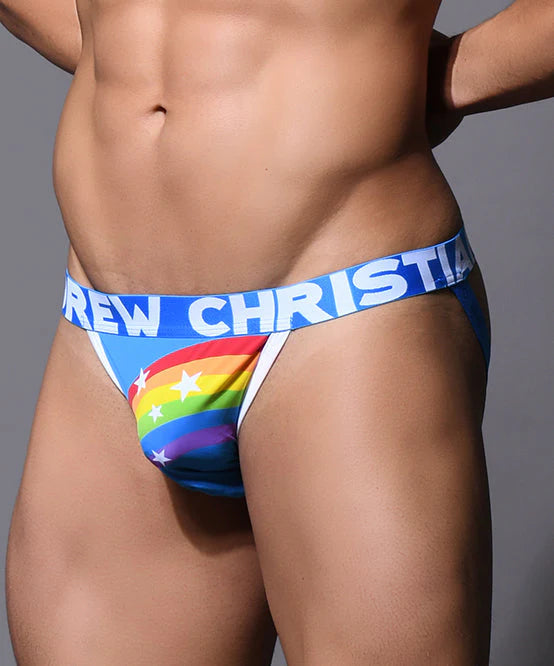
For briefs, boxers and jocks, start with the brand's waistband measurement. Then look at pouch construction and leg opening. The Rainbow Jock with Almost Naked uses four-way-stretch polyamide and spandex, but even generous stretch cannot fix the wrong waistband size.
A five-minute fit shortlist
- Measure only the points the garment uses.
- Open the chart for that brand and product.
- Match the least stretchy or most structured section first.
- Note what adjusts—and what does not.
- Compare coverage, cup shape, torso length and leg line.
- Confirm every included piece and selected variant.
- Read the care and returns information before opening the packaging.
The better choice is often the one with more useful information, not more adjectives.
Frequently asked questions
What if I fall between two sizes?
Prioritise the least flexible area. For an underwired chemise that may be the cup or band; for a teddy it may be torso length or hip. If both sizes still look plausible, ask us about the garment rather than borrowing another brand's chart.
Does one size mean the fabric will fit everyone?
No. It identifies a range within that brand. Look for the body measurements, height guidance and construction of the garment.
Do adjustable straps fix cup or torso fit?
They alter strap length and where the garment sits. They do not change cup width, underwire shape, waistband size or the full length through a one-piece garment.
Can I open or try on lingerie in store?
No. Lingerie cannot be opened or tried on in store. Compare the sealed packaging, size chart, cut, listed measurements and included pieces, and ask our team for sizing help before buying.
Find the shape that feels like you
Shop our warehouse sale online at 50% off retail, with same-day dispatch for eligible orders placed before 3 pm Sydney time, Monday to Saturday, free Standard shipping on eligible online orders of $150 or more after discounts, discreet billing and plain packaging. Or visit Alexandria or Rydalmere to compare labels, size charts, cuts and packaging in person.
Products from this guide
SEVEN TIL MIDNIGHT
Two Piece Lace and Satin Chemise Set STM-11829P-Black-O/S
In stock
View product